2024 ARC Nationals
2024 ARC Nationals
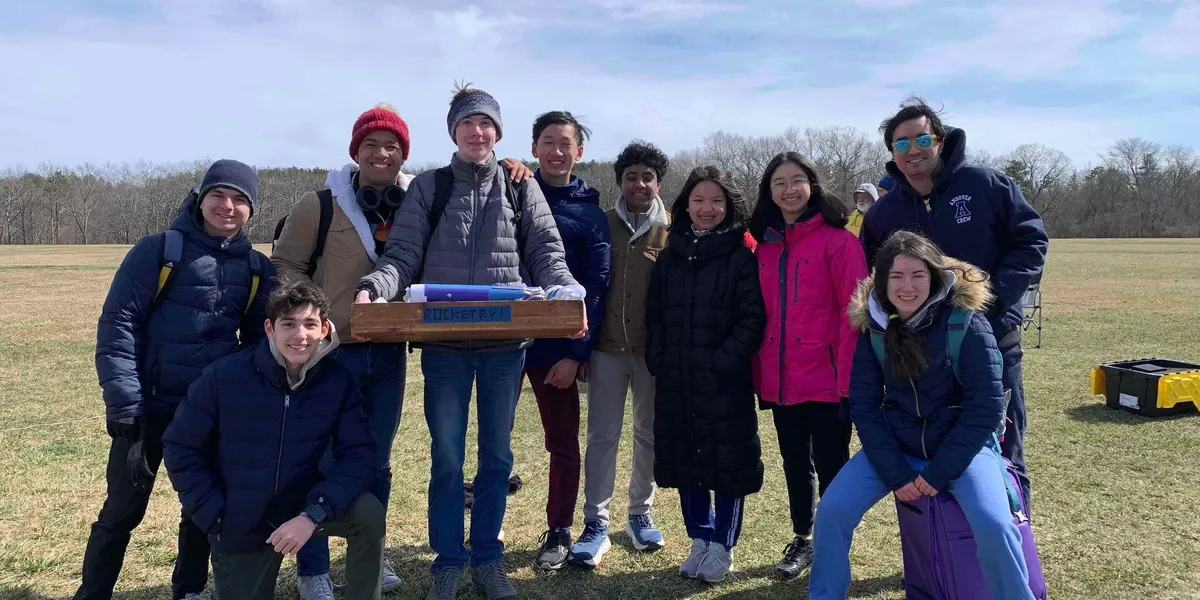
In just our first year as a team, the Big Blue Boom Crew placed in the top 6% at the American Rocketry Challenge Nationals after having constructed two ammonium perchlorate powered rockets from scratch and conducting both simulation and field based testing.
Year
2024
Category
Engineering
My Experience
My Experience
I joined the Andover Rocketry Club midway through the competition season. By the time I joined, we already had two rockets in progress, which I helped refine. Our hard work paid off, as we eventually ranked in the top 10% nationally, earning a spot at the American Rocketry Challenge (ARC) Nationals.
I joined the Andover Rocketry Club midway through the competition season. By the time I joined, we already had two rockets in progress, which I helped refine. Our hard work paid off, as we eventually ranked in the top 10% nationally, earning a spot at the American Rocketry Challenge (ARC) Nationals.
My Experience
I joined the Andover Rocketry Club midway through the competition season. By the time I joined, we already had two rockets in progress, which I helped refine. Our hard work paid off, as we eventually ranked in the top 10% nationally, earning a spot at the American Rocketry Challenge (ARC) Nationals.
About our Rocket
About our Rocket
Scrambled was our competition rocket for the 2023-2024 competition season, our very first as a team. It stood at a height of 71.5cm and a max diameter of 6.6cm. Scrambled's final launch mass was approximately 335g and utilized an Aerotech E20-4W engine in its propulsion system. Our first-ever rocket, Scrambled launched to an apogee of 800ft at the American Rocketry Challenge National Finals, a mere 20ft lower than the rocket's design goal. All rocket systems functioned excellently at the National Finals, and Scrambled was recovered with no damage.
Scrambled was our competition rocket for the 2023-2024 competition season, our very first as a team. It stood at a height of 71.5cm and a max diameter of 6.6cm. Scrambled's final launch mass was approximately 335g and utilized an Aerotech E20-4W engine in its propulsion system. Our first-ever rocket, Scrambled launched to an apogee of 800ft at the American Rocketry Challenge National Finals, a mere 20ft lower than the rocket's design goal. All rocket systems functioned excellently at the National Finals, and Scrambled was recovered with no damage.
About our Rocket
Scrambled was our competition rocket for the 2023-2024 competition season, our very first as a team. It stood at a height of 71.5cm and a max diameter of 6.6cm. Scrambled's final launch mass was approximately 335g and utilized an Aerotech E20-4W engine in its propulsion system. Our first-ever rocket, Scrambled launched to an apogee of 800ft at the American Rocketry Challenge National Finals, a mere 20ft lower than the rocket's design goal. All rocket systems functioned excellently at the National Finals, and Scrambled was recovered with no damage.
The Future
The Future
The 2025 American Rocketry Challenge season is here, and we have plenty of innovative ideas. One key system we're developing is air-braking, which will enable our rocket to monitor its real-time altitude, velocity, acceleration, and inertia. Using this data, the software will determine the optimal moment to deploy "air brakes"—panels made of PETG/Fiberglass that extend from the rocket at specific angles to create drag and reduce speed. With thorough testing and refinement, Boom Crew's rockets will be able to hit their target altitude with precision.
The 2025 American Rocketry Challenge season is here, and we have plenty of innovative ideas. One key system we're developing is air-braking, which will enable our rocket to monitor its real-time altitude, velocity, acceleration, and inertia. Using this data, the software will determine the optimal moment to deploy "air brakes"—panels made of PETG/Fiberglass that extend from the rocket at specific angles to create drag and reduce speed. With thorough testing and refinement, Boom Crew's rockets will be able to hit their target altitude with precision.
The Future
The 2025 American Rocketry Challenge season is here, and we have plenty of innovative ideas. One key system we're developing is air-braking, which will enable our rocket to monitor its real-time altitude, velocity, acceleration, and inertia. Using this data, the software will determine the optimal moment to deploy "air brakes"—panels made of PETG/Fiberglass that extend from the rocket at specific angles to create drag and reduce speed. With thorough testing and refinement, Boom Crew's rockets will be able to hit their target altitude with precision.
More Works More Works
More Works More Works
Alfonso
Alfonso
Alfonso
Alfonso
IG | Poncho.2008
GO BACK TO TOP
IG | Poncho.2008
GO BACK TO TOP